 Wadi Rum Desert Tours
Best Time to Visit Wadi Rum: Month-by-Month Guide
The best time to visit Wadi Rum is March to May and September to November, when afternoon highs sit between about 21°C (70°F) and 32°C (90°F), nights are mild enough for a camp and rain is close to zero. Those are the windows Wikivoyage recommends, and the desert numbers back them up. Summer works if you accept about 34°C (93°F) afternoons and a schedule pushed to early morning and sunset. Winter trades hot days for nights near 3°C (38°F) in camp. This guide gives the full month-by-month climate picture from long-term data, explains what changes with the seasons and matches the seasons to the Wadi Rum desert tours in the catalogue, from sunrise balloon flights to cave camping.
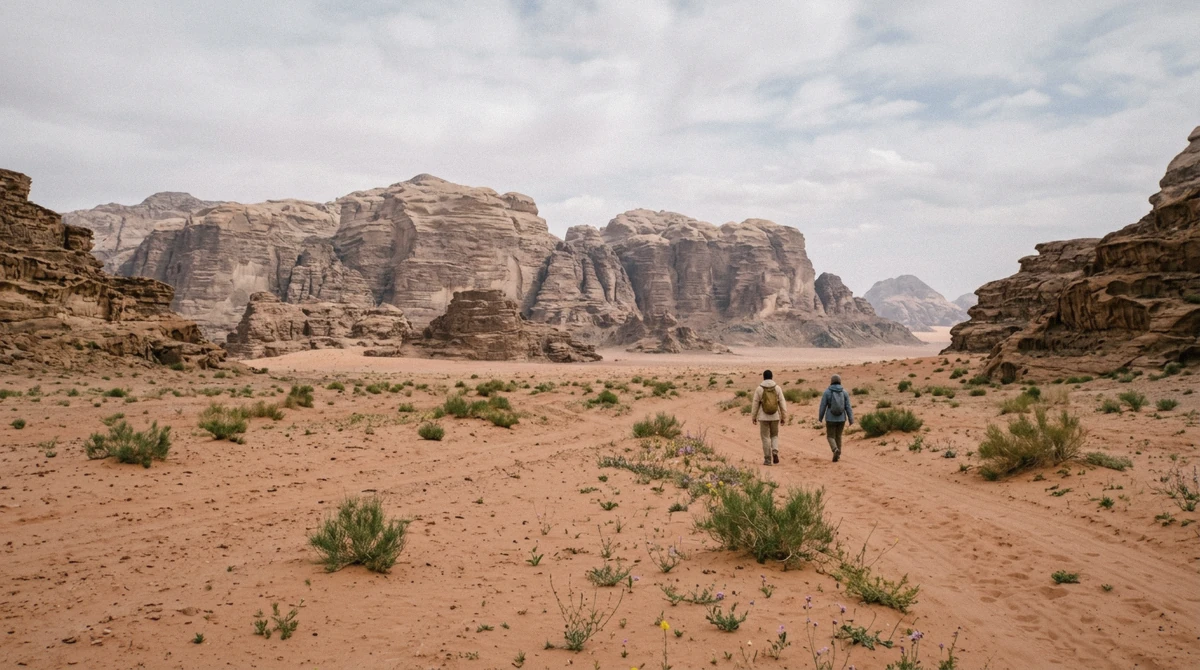
Illustrative image of a spring morning in the valley.
Quick answer Spring and autumn are best, summer means heat, winter means cold nights
The best months for Wadi Rum are March to May and September to November. Daytime highs in those windows run from 20.8°C (69°F) in March to 29.7°C (85°F) in May, with comfortable nights for camping. July and August are the hardest months, with average highs of 34.2°C (94°F) and 34.5°C (94°F), so desert time shifts to early morning and sunset. January is the coldest month, averaging 14.4°C (58°F) by day and 3.2°C (38°F) at night, so camp nights need warm clothes. Rain is rare all year and never exceeds 7.1 mm in a typical month.
Key takeaways
- March to May and September to November are the sweet spots for warm days and camp-friendly nights.
- In July and August, average highs hit about 34°C (93°F), so tours lean on morning and sunset slots like the Wadi Rum Half-Day Private Jeep Tour: Morning, Sunset or with a Camel Ride.
- January nights average 3°C (38°F), so any camp or cave night needs a real warm layer.
- The Hot Air Balloon Flight over Wadi Rum at Sunrise flies at first light, when the desert is coolest and calmest.
- For the darkest skies, pair a moonless night with Wadi Rum Stargazing with an Astronomer and Telescopes, since cloud and moonlight change what you see.
Best Season by Traveler Type
If Photographer chasing soft light and clear air
Go in March to May or October to November, when long golden hours and around 11.5 to 13.6 hours of daylight give time to work. A cave camping night puts you inside the reserve for both ends of the light.
If Family with children
Pick April or October to November. Afternoons stay below 28°C (82°F), nights are not freezing and the half-day jeep format with a morning or sunset private tour keeps exposure to heat short.
If First-timer who wants the safest bet
Book March, April, October or November. These months avoid both the summer heat and the coldest nights, and a full overnight listing such as the full-day jeep tour with a camp night covers the whole arc in one booking.
If Budget traveler with flexible dates
Consider winter, December to February. Daytime highs of 14.4°C (58°F) to 16.5°C (62°F) in January and February are fine for walking, and the trade-off is a camp night near 3°C (38°F). The cheapest full package in the catalogue runs year round at $53 per person.
If Stargazer with fixed summer dates
Go in June to August anyway, but plan desert time before 10:00 and after sunset, then add an observatory session after dark. Warm nights around 20°C (68°F) make waiting up for the stars easy.
Seasons at a Glance
The verdicts below come from the long-term climate numbers for Wadi Rum, not from any crowd count. Read the Verdict column as a judgement on comfort for the standard tour formats here: jeep days, camel rides, camp nights and sunrise flights. Rain in this desert is so slight that it rarely changes a plan.
The first table condenses the year into conditions, daylight, rain and a verdict for the typical traveler booking a jeep tour or a camp night.
| Month | Typical conditions | Daylight | Rain | Verdict |
|---|---|---|---|---|
| January | Cool days, cold nights | 10.5 hours | 7.1 mm | Good, pack warm |
| February | Cool days, cold nights | 11.1 hours | 6.3 mm | Good, pack warm |
| March | Warm days, mild nights | 12.0 hours | 6.8 mm | Best overall |
| April | Warm days, mild nights | 12.9 hours | 3.1 mm | Best overall |
| May | Hot afternoons, mild nights | 13.6 hours | 2.2 mm | Very good |
| June | Hot days, warm nights | 14.0 hours | 0.1 mm | Heat, shift hours |
| July | Hottest days, warm nights | 13.8 hours | 0.0 mm | Heat, shift hours |
| August | Hottest days, warm nights | 13.2 hours | 0.3 mm | Heat, shift hours |
| September | Hot days, warm nights | 12.3 hours | 0.3 mm | Very good |
| October | Warm days, mild nights | 11.5 hours | 4.0 mm | Best overall |
| November | Warm days, cool nights | 10.7 hours | 2.5 mm | Best overall |
| December | Cool days, cold nights | 10.3 hours | 4.9 mm | Good, pack warm |
Read the verdicts as a comfort score. The three months rated best overall sit far enough from both extremes that a full desert day and a night in camp both work without special gear. Winter verdicts reflect the cold nights more than the days, and the summer verdicts reflect heat management rather than any risk of rain.
The second table gives the numbers behind those verdicts. Figures are typical monthly averages from the Open-Meteo ERA5 reanalysis for Wadi Rum, built on daily data for 2001 to 2025. Check the current forecast close to your dates, since any single week can sit above or below the average.
| Month | Average high | Average low | Rain |
|---|---|---|---|
| January | 14.4°C (58°F) | 3.2°C (38°F) | 7.1 mm |
| February | 16.5°C (62°F) | 4.4°C (40°F) | 6.3 mm |
| March | 20.8°C (69°F) | 7.6°C (46°F) | 6.8 mm |
| April | 25.5°C (78°F) | 11.4°C (53°F) | 3.1 mm |
| May | 29.7°C (85°F) | 15.6°C (60°F) | 2.2 mm |
| June | 32.8°C (91°F) | 18.4°C (65°F) | 0.1 mm |
| July | 34.2°C (94°F) | 20.2°C (68°F) | 0.0 mm |
| August | 34.5°C (94°F) | 20.3°C (69°F) | 0.3 mm |
| September | 32.2°C (90°F) | 18.4°C (65°F) | 0.3 mm |
| October | 27.8°C (82°F) | 15.0°C (59°F) | 4.0 mm |
| November | 21.2°C (70°F) | 9.1°C (48°F) | 2.5 mm |
| December | 16.1°C (61°F) | 4.7°C (40°F) | 4.9 mm |
By the numbers, July and August are the hottest months at about 34°C (93 to 94°F) by day, January is the coldest at 3.2°C (38°F) at night, and January is also the wettest at 7.1 mm, which still counts as desert-dry. Nights run 11 to 14 degrees colder than afternoons in every month, which is the single number that decides what you pack.
Climate figures: Open-Meteo historical weather API, ERA5 daily data for Wadi Rum. Seasonal advice: Wikivoyage Wadi Rum.
Spring (March to May): Warm Days, Perfect Camp Nights
Spring is the first of the two sweet spots, and the numbers explain why. March opens at 20.8°C (69°F) by day and 7.6°C (46°F) at night, April reaches 25.5°C (78°F) and 11.4°C (53°F), and May climbs to 29.7°C (85°F) with nights of 15.6°C (60°F). Daylight stretches from 12.0 hours in March to 13.6 in May, so a full-day route has room for every stop without rushing.
Rain stays in the low single millimetres and rarely interferes.
- Temperatures: 20.8°C (69°F) to 29.7°C (85°F) by day, 7.6°C (46°F) to 15.6°C (60°F) at night
- Daylight: 12.0 to 13.6 hours, the days are long enough for the full circuit of stops
- Rain: 2.2 to 6.8 mm a month, close to irrelevant in practice
- Trade-off: May afternoons already feel hot in the open jeep, so morning starts earn their keep
This is the season where an overnight format shows its full value. The Wadi Rum Full-Day Jeep Tour with Overnight and Dinner in a Bedouin Camp runs a jeep day from 10:00 to sunset across ten sites, then a night in a private tent, and its listing notes that nights outside summer still call for a warm layer, which in spring means a light one.
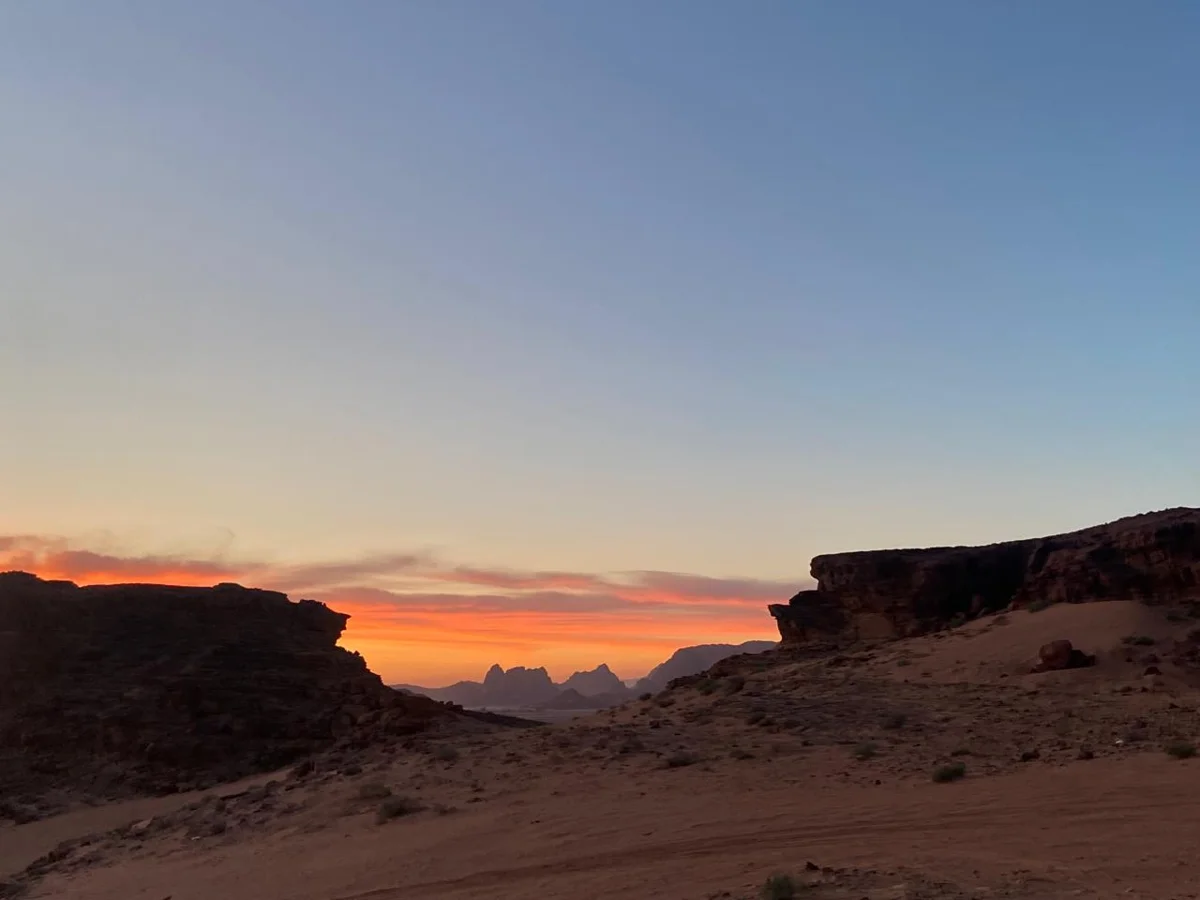
Dusk over the ridges of Wadi Rum. Photo: Sura ah83, CC0, via Wikimedia Commons.
Summer (June to August): Heat, Early Starts and Long Evenings
Summer is the season to plan around, not to skip outright. June averages 32.8°C (91°F) by day, and July and August average 34.2°C (94°F) and 34.5°C (94°F). Nights stay warm at about 20°C (68°F), which makes camp life easy and stargazing comfortable.
The cost is the afternoon: open jeeps, walking between stops and sandboarding all feel harder once the sun is high.
- Temperatures: 32.8°C (91°F) to 34.5°C (94°F) by day, about 20°C (68°F) at night
- Daylight: 13.2 to 14.0 hours, the longest days of the year
- Rain: effectively zero, 0.0 to 0.3 mm a month
- Trade-off: desert time shifts to early morning and sunset, so a full-day route compresses its walking into the cooler edges
The half-day private format fits this season best. The Wadi Rum Half-Day Private Jeep Tour: Morning, Sunset or with a Camel Ride offers a 4-hour morning tour or a 4-hour sunset tour at Um Sabatah, so you can book the cooler end of the day and stay out of the midday heat entirely.
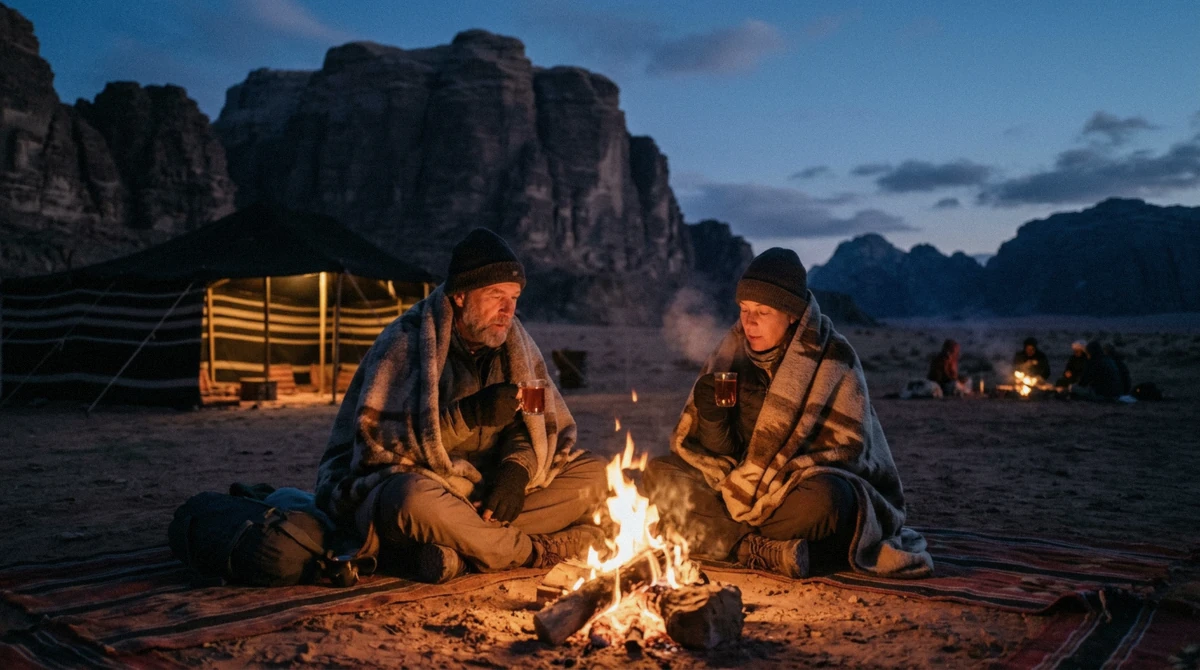
Illustrative image of a winter evening at a desert camp.
Autumn (September to November): The Second Sweet Spot
Autumn mirrors spring with its own character. September still carries summer warmth at 32.2°C (90°F), October settles to 27.8°C (82°F), and November lands at 21.2°C (70°F) with nights of 9.1°C (48°F). Rain stays low at 0.3 to 4.0 mm.
The light lowers through the season, the walking gets easier month by month and the camp nights stay pleasant until the real cold arrives in December.
- Temperatures: 21.2°C (70°F) to 32.2°C (90°F) by day, 9.1°C (48°F) to 18.4°C (65°F) at night
- Daylight: 10.7 to 12.3 hours, still enough for a full route
- Rain: 0.3 to 4.0 mm a month
- Trade-off: September afternoons are still hot, so treat it as a summer month for scheduling
The long-format day tour suits the season well. The Wadi Rum 9-Hour Jeep Tour with Camel Ride, Sandboarding and Lunch runs 9 to 12 sites depending on pace and season, with an 80-minute lunch stop and plenty of walking, which is far more appealing at 27°C (81°F) than at 34°C (93°F).
Winter (December to February): Quiet Cold and Clear Skies
Winter is underrated for the days and demanding for the nights. December averages 16.1°C (61°F) by day, January 14.4°C (58°F) and February 16.5°C (62°F). Those are excellent walking temperatures under a low sun.
The catch is the drop: January nights average 3.2°C (38°F) and December nights 4.7°C (40°F), and desert nights run 11 to 14 degrees colder than afternoons in every month. Some listings explicitly say to bring warm clothes for winter nights, and one cave camping listing calls its night semi-wild camping, which makes the layer non-negotiable.
For a winter trip, a tent with a bathroom beats a cave. The Wadi Rum Bedouin Camp Stay with a Full-Day Desert Tour and 3 Meals includes a private tent for 1 to 3 guests with private bathroom and shower, its listing asks for warm clothes in winter, and at $53 per person it is the lowest full-package rate in the catalogue.
The other winter advantage is the sky. Winter also gives the most hours of darkness for the stars, and the observatory session runs about 1.5 hours whatever the season.
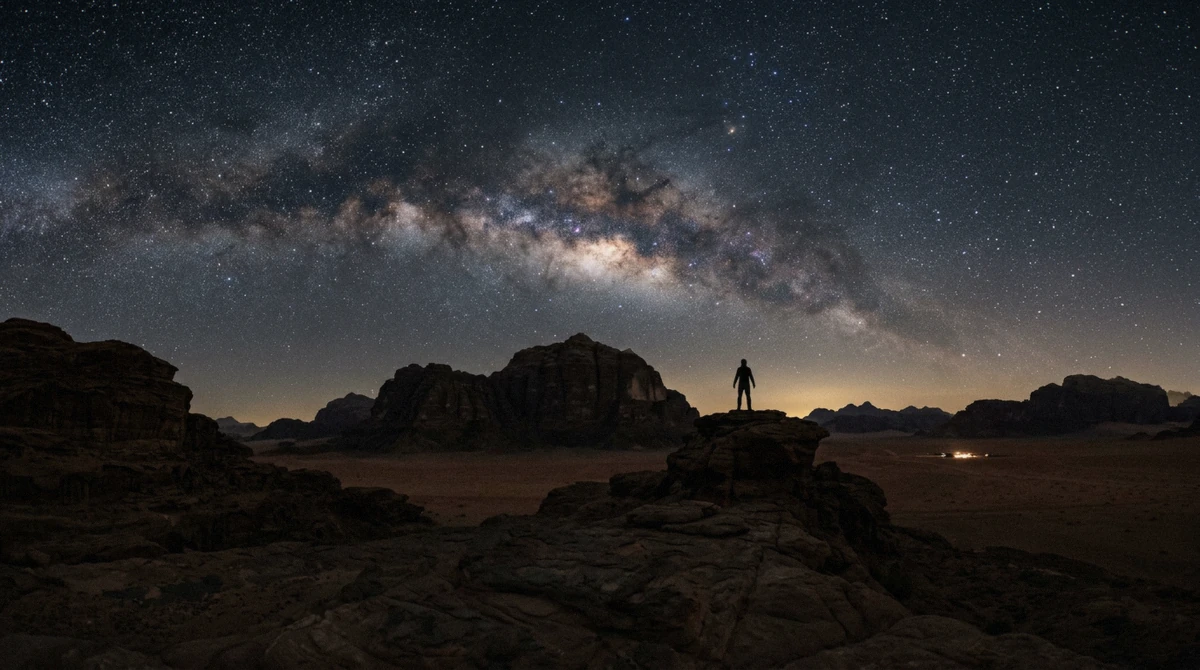
Illustrative image of the night sky over the desert.
The Worst Time to Visit, Honestly
The hardest window is July to August for anyone sensitive to heat. Average afternoon highs of about 34°C (93 to 94°F) in an open jeep, with walking and scrambling at the stops, mean the middle of the day is time to avoid rather than use. Tour formats adapt by shifting to early morning and sunset, but a traveler who wants a full day of desert from morning to dusk will find summer the least cooperative season.
Book summer trips around a morning start and a late return, and keep the long 9-hour routes for another season.
Who summer still works for: stargazers, since the nights are warm and the rain is zero, and travelers whose whole schedule runs on sunrise and sunset slots, including balloon flights, which launch at first light for exactly this reason. Who should avoid it: families with small children on walking-heavy itineraries and anyone who struggles in heat.
If you only have one morning, the ranked shortlist is simple. April first, with 25.5°C (78°F) highs and 12.9 hours of daylight. October second, at 27.8°C (82°F) with cooling nights.
March third, at 20.8°C (69°F), cooler but with a touch more rain risk. November fourth, at 21.2°C (70°F), with the shortest daylight of the four.
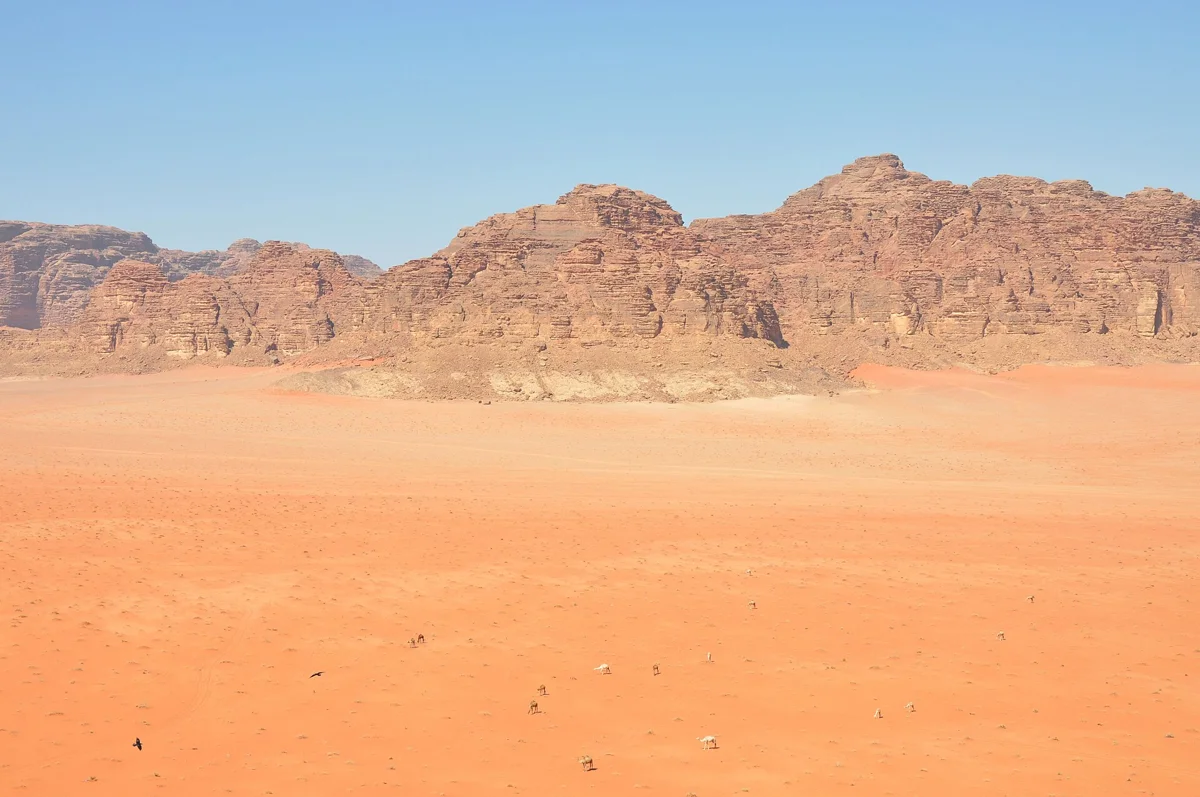
Open sand and cliffs in the Wadi Rum valley. Photo: Jorge Láscar from Australia, CC BY 2.0, via Wikimedia Commons.
What Actually Affects Conditions in Wadi Rum
Most people assume rain is the thing that ruins a desert trip. In Wadi Rum it barely matters, with under 8 mm in even the wettest typical month. What actually shapes your day is the swing between afternoon and night, which runs 11 to 14 degrees in every month, and the strength of the sun in an open vehicle with almost no shade.
That swing is why the same tour feels like two different trips at 10:00 and at 15:00 in July.
Wind matters more than rain for specific activities. The balloon listing states plainly that flights depend on the wind and can be cancelled for weather, which is why the sensible play is to book the flight for your first morning and keep a second morning as a backup. For stargazing, the observatory notes that cloud and moonlight change what you see, so a moonless night in a dry month gives the darkest sky.
The driest stretch runs June to September at 0.0 to 0.3 mm a month.
Daylight is the third lever. It ranges from 10.3 hours in December to 14.0 hours in June, which decides whether a route that lists twelve sites fits comfortably into one day or needs the pace relaxed.
Best Time of Day for Each Activity
For jeep tours, the advantage goes to the edges of the day, and the right edge depends on the season. In summer, morning wins: the jeep tour in the overnight listing starts at 10:00 and runs to sunset, and a half-day format can start even earlier. In the cooler months, the sunset option carries the payoff, with the half-day private tour ending at Um Sabatah for the light.
The direct recommendation is a morning start in June to August and a sunset start in October to March.
The Hot Air Balloon Flight over Wadi Rum at Sunrise has no choice and would not want one. It launches at sunrise, when the air is coolest and calmest, and the whole experience runs about 2.5 hours including transfers. Because flights depend on wind, book it for your first morning in the desert and hold the second morning free as a backup.
Camel rides are flexible on start time, chosen at booking, and the same logic applies as for jeeps. The Wadi Rum Camel Ride with Bedouin Tea and Guide runs a 1-hour ride with a tea stop at the red sand dune, and morning or late afternoon keeps both the rider and the sun comfortable.
Stargazing is the one activity that belongs after dark by definition. The observatory session runs about 1.5 hours once night has settled, with free transfer from most camps. General advice for the darkest sky is a night close to the new moon, since moonlight changes what the telescopes and the naked eye can pick out.
What Trips Cost Through the Year
The listings in the top Wadi Rum desert tours catalogue carry one price per person all year, so the season changes what you pack, not the rate on the page. The cheapest full package, a day tour and a camp night with three meals, is $53 per person. The half-day private jeep tour is $72.50, the 9-hour jeep day with camel ride and sandboarding is $64, the cave camping overnight is $126, the overnight jeep and camp trip is $106.53, the sunrise balloon is $235, the camel ride is $49, the stargazing session is $30 and the Petra and Wadi Rum day trip from Amman is $94.
One cost does not change with the season either: the protected-area entrance fee of 5 JD ($7.05) per person for foreign visitors, paid at the Visitor Centre and covered by the Jordan Pass. No tour in the catalogue includes it, and several listings quote the fee higher, so carry cash for the larger figure. If you are linking the desert to Petra, the Jordan Wanderer pass at 70 JD ($98.70) covers Wadi Rum entry along with a Petra day.
For context on arranging things independently in the village, Wikivoyage gives reference prices of 50 to 75 JD ($70.50 to $105.75) per jeep for 3 to 5 hours, about 20 JD ($28.20) per hour for a camel and 20 to 80 JD ($28.20 to $112.80) per person per night for camps with meals. Those are walk-up figures for comparison, not catalogue prices.
So, When Should You Go?
Go in March to May or September to November. Those windows give you highs between about 21°C (70°F) and 32°C (90°F), nights that make a camp or cave night a pleasure, long enough days for the full circuit of stops and rain so rare it is a footnote. If budget leads, December to February works well for daytime exploring at 14.4°C (58°F) to 16.5°C (62°F), provided you pack a serious warm layer for nights that drop toward 3°C (38°F).
The window to treat with respect is June to August, when about 34°C (93°F) afternoons push everything to early morning and sunset. Whichever month you pick, start from the catalogue of top Wadi Rum desert tours and match the format to the season.
Questions and Answers
What is the best month to visit Wadi Rum?
There is no single standout, but March, April, October and November are the strongest picks, with highs from 20.8°C (69°F) to 27.8°C (82°F) and mild nights. May and September are close behind if you handle afternoon heat of around 30°C (86°F) to 32°C (90°F).
Is Wadi Rum cold at night?
Yes, outside summer. Nights run 11 to 14 degrees colder than afternoons, from an average low of 3.2°C (38°F) in January to 15.6°C (60°F) in May. Bring a warm layer for any camp or cave night between October and April, which is exactly what the overnight listings advise.
Is it too hot to visit Wadi Rum in summer?
Not if you plan around it. July and August average about 34°C (93 to 94°F) by day, so tours shift desert time to early morning and sunset, and nights near 20°C (68°F) are comfortable. Walking-heavy full-day routes are simply harder work in those months.
Does it rain in Wadi Rum?
Very little. Rain peaks at 7.1 mm in a typical January and drops to 0.0 mm in July, based on long-term averages for 2001 to 2025. Check the current forecast close to your dates, but rain rarely changes a plan here.
Is sunset or sunrise better in Wadi Rum?
For jeep tours, take a sunrise or morning start in summer and a sunset start in the cooler months, when the half-day tour ends at Um Sabatah for the light. For the balloon there is no choice, it flies at sunrise when the air is calmest.
How many days do you need in Wadi Rum?
One overnight is the core experience, covering a full jeep day and a night in camp. Adding a second morning protects a balloon booking against a wind cancellation and leaves room for a camel ride or the observatory. A longer breakdown is in the guide on how long to spend in Wadi Rum.